
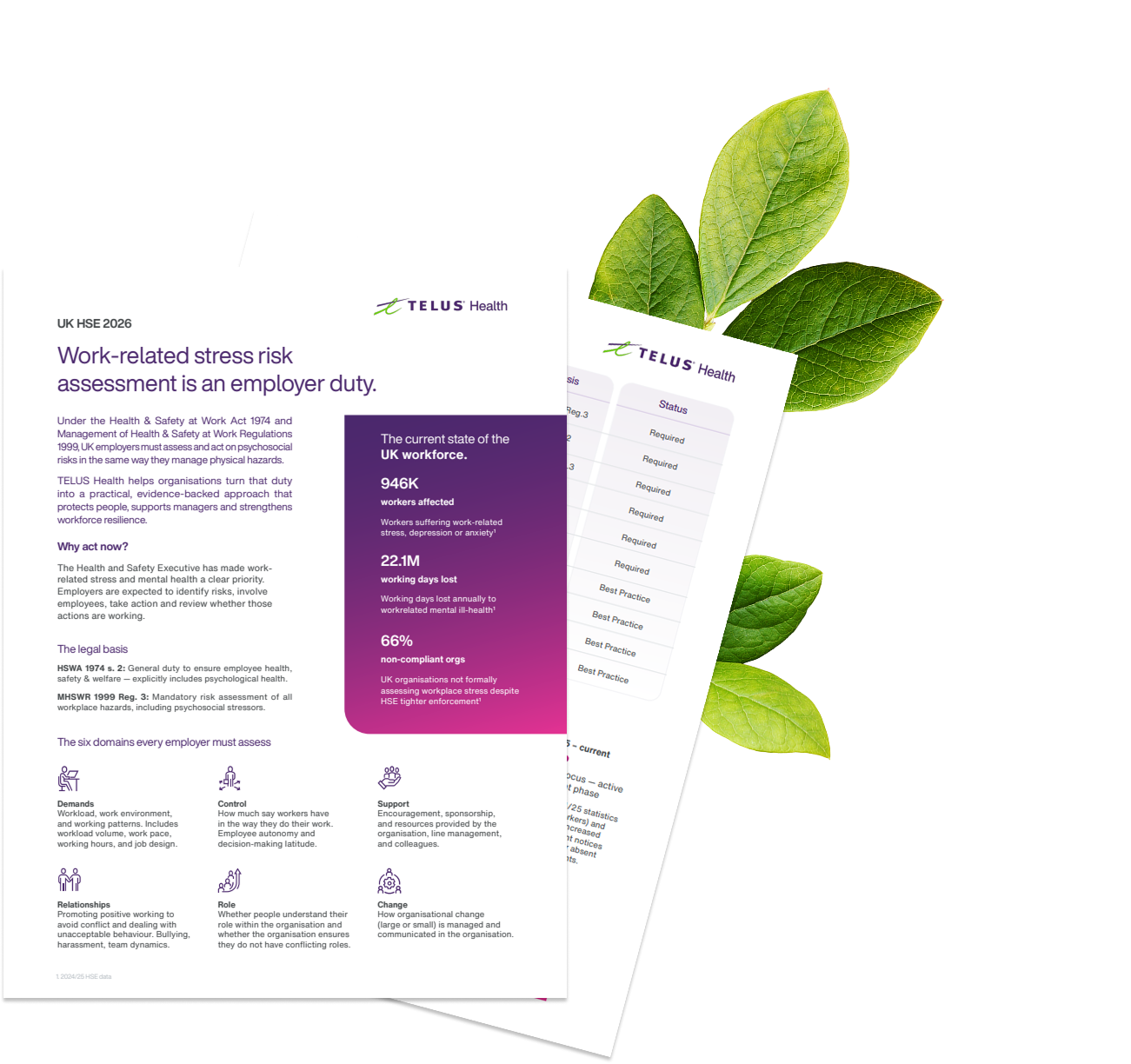

UK HSE: Work-related stress risk assessment is an employer duty
Under the Health & Safety at Work Act 1974 and Management of Health & Safety at Work Regulations 1999, UK employers are expected to assess and act on work-related stress risks in the same way they manage other workplace health and safety risks.
TELUS Health helps organisations turn that duty into a practical, evidence-backed approach that protects people, supports managers and strengthens workforce resilience.

Wellbeing is now a compliance priority.
Why act now?
The legal duty is not new. What has changed is the level of scrutiny, the scale of workforce strain, and the need for employers to show clear evidence of action.
The Health and Safety Executive has made work-related stress and mental health a clear priority. Employers are expected to identify risks, involve employees, take action, and review whether those actions are working.
For HR leaders, this is no longer just about offering support. Organisations need to offer a clear, documented and repeatable process.

Penalty exposure for non-compliance.
Psychosocial and physical safety penalties are the same — including organisational and personal liability for senior officers.
Unlimited
Maximum Financial Fine
Typical: £10K–£1M+
£1.2M
Stress Case Precedent
Uber fine (2024)
£500K
Individual Liability
+ up to 2 yrs prison
£2M
Min Insurance Cover
Employer liability
What must be assessed
According to HSE guidelines, Employers should assess the causes of work-related stress, act on the findings and clearly document the process.
That means going beyond awareness campaigns or one-off resilience training. Employers need to understand where pressure is coming from, how it affects their people and what practical controls are being put in place.
For HR leaders, this is no longer just about offering support. Organisations need to offer a clear, documented and repeatable process.
A strong approach should help you:
-
Identify areas of stress risk
-
Involve employees and managers in the process
-
Create an action plan based on real workplace factors
-
Provide timely support when people need help
-
Review progress and evidence what has changed
The legal duty
- HSWA 1974 s. 2: General duty to ensure employee health, safety & welfare — explicitly includes psychological health.
- MHSWR 1999 Reg. 3: Mandatory risk assessment of all workplace hazards, including psychosocial stressors
- Mental health risks must be assessed in the same way as physical hazards — no distinction in law
- Employers must act on assessment findings — documentation alone is insufficient
- HSE's Management Standards provide the expected assessment framework
964K
Workers suffering work-related stress, depression or anxiety1
22.1M
Working days lost annually to work-related mental ill-health1
66%
UK organisations not formally assessing workplace stress
The six domains every employer must assess
-
Demands
Workload, work environment, and working patterns. Includes workload volume, work pace, working hours, and job design.
-
Control
How much say workers have in the way they do their work. Employee autonomy and decision-making latitude.
-
Support
Encouragement, sponsorship, and resources provided by the organisation, line management, and colleagues.
-
Relationships
Promoting positive working to avoid conflict and dealing with unacceptable behaviour. Bullying, harassment, team dynamics.
-
Role
Whether people understand their role within the organisation and whether the organisation ensures they do not have conflicting roles.
-
Change
How organisational change (large or small) is managed and communicated in the organisation.
1. 2024/25 HSE Data